

Tamil Marriage Invitation Card Online
தமிழ் திருமண அழைப்பிதழ் | திருமண அழைப்பிதழ் தமிழில் | Thirumana Alaipithal
Design your traditional Tamil wedding invitation in minutes. Free templates, Muhurtham & Nakshatra fields, bilingual editor, instant PDF & WhatsApp download.
Instant Invitation
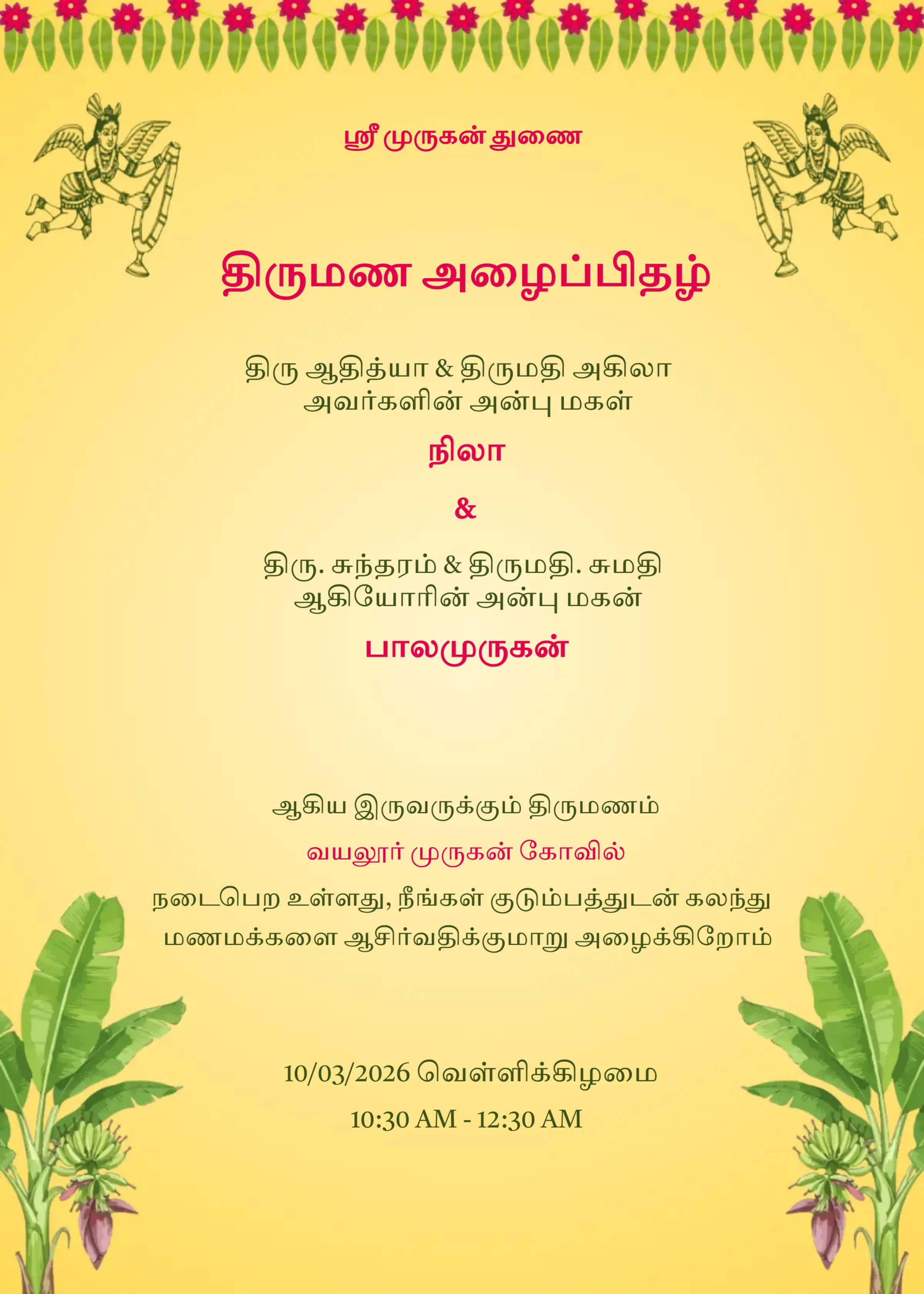
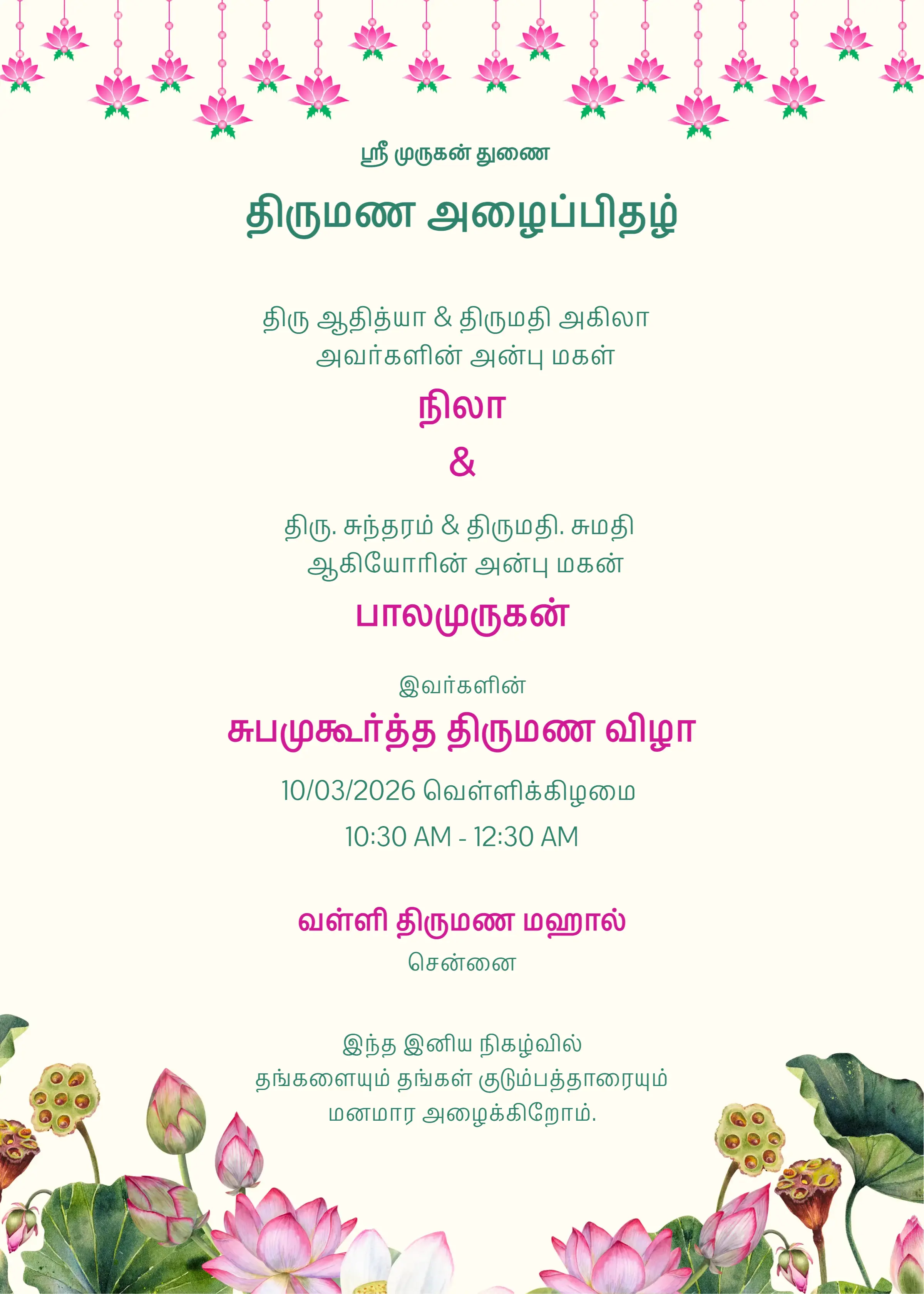
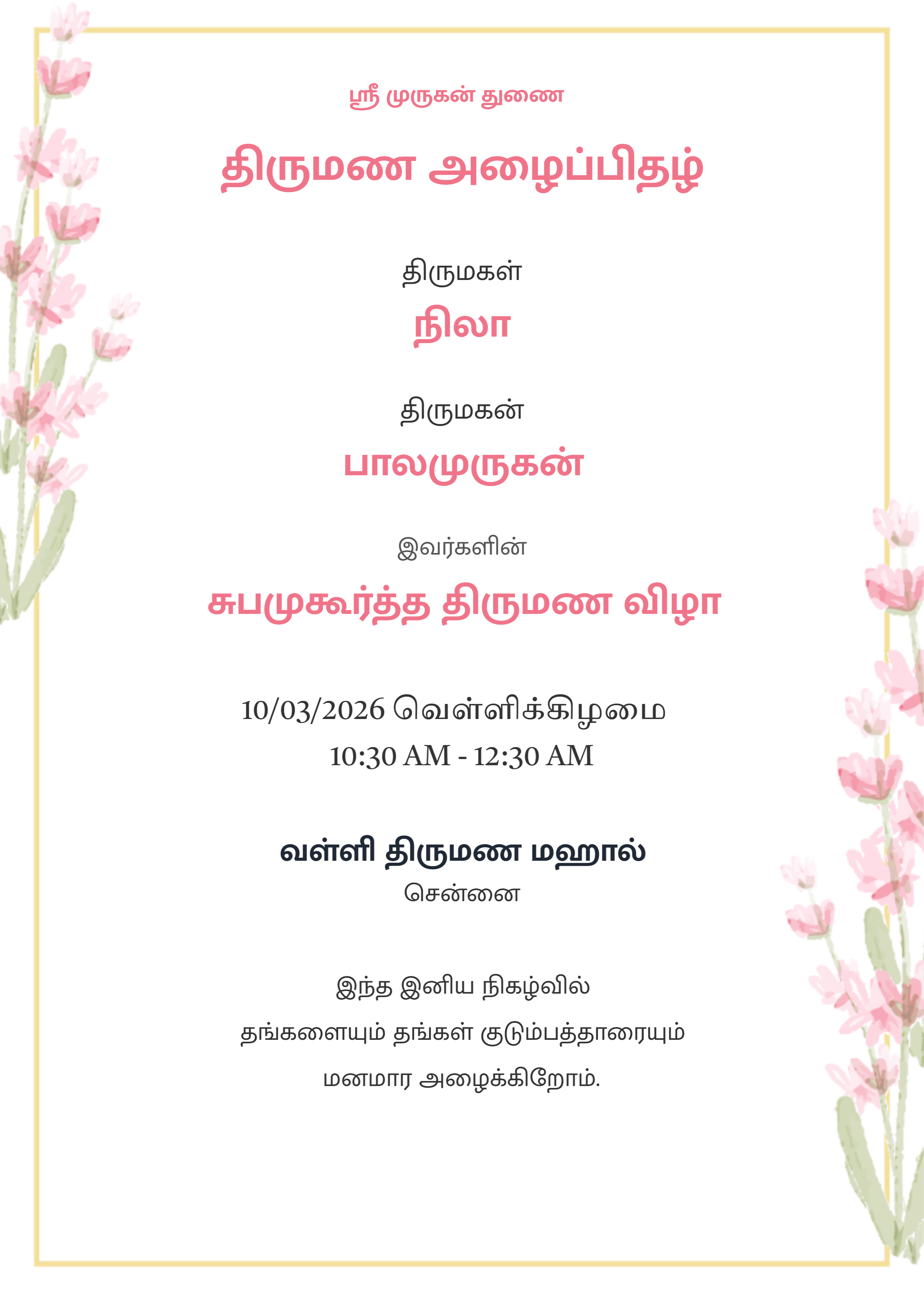
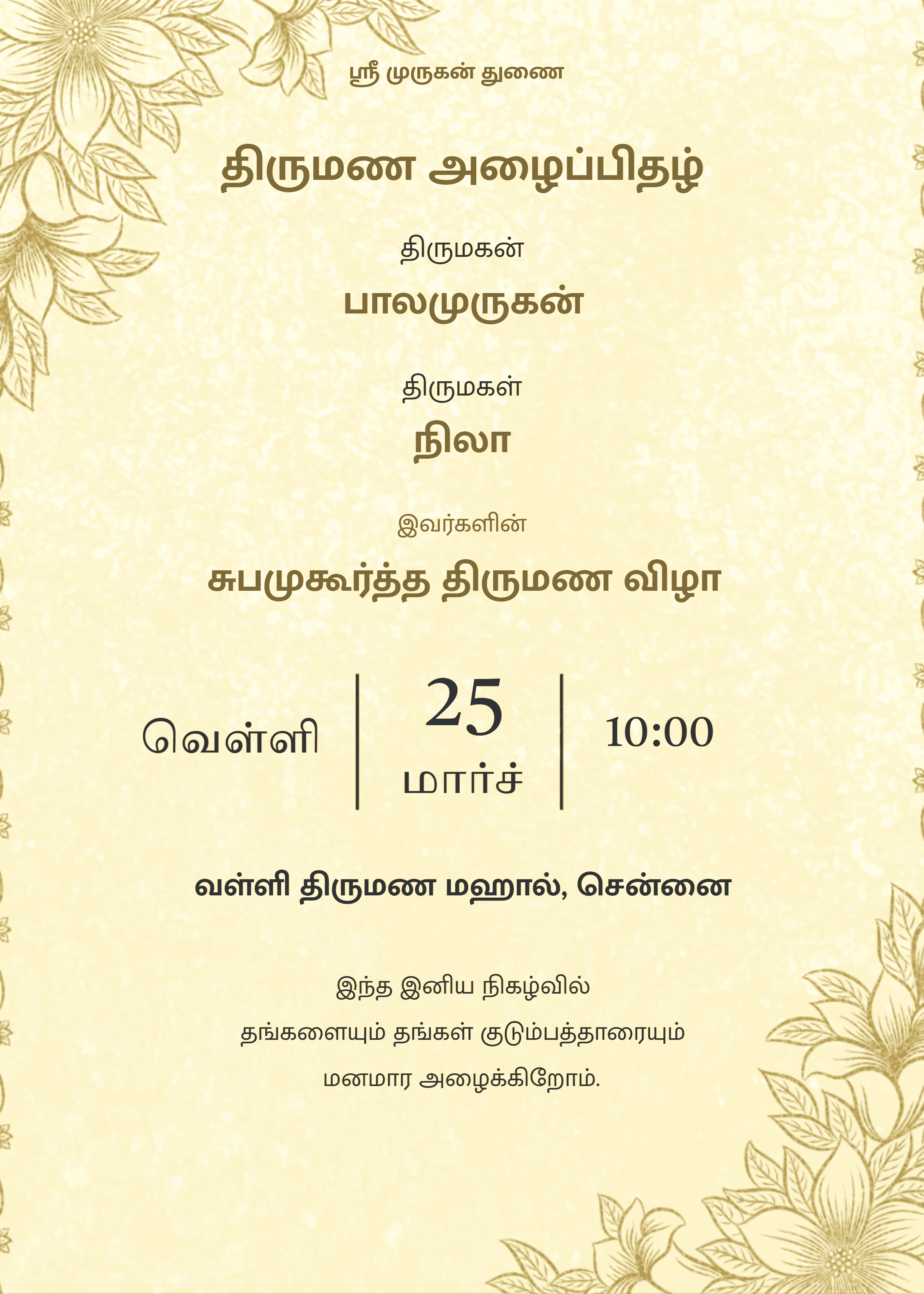
Premium Invitation
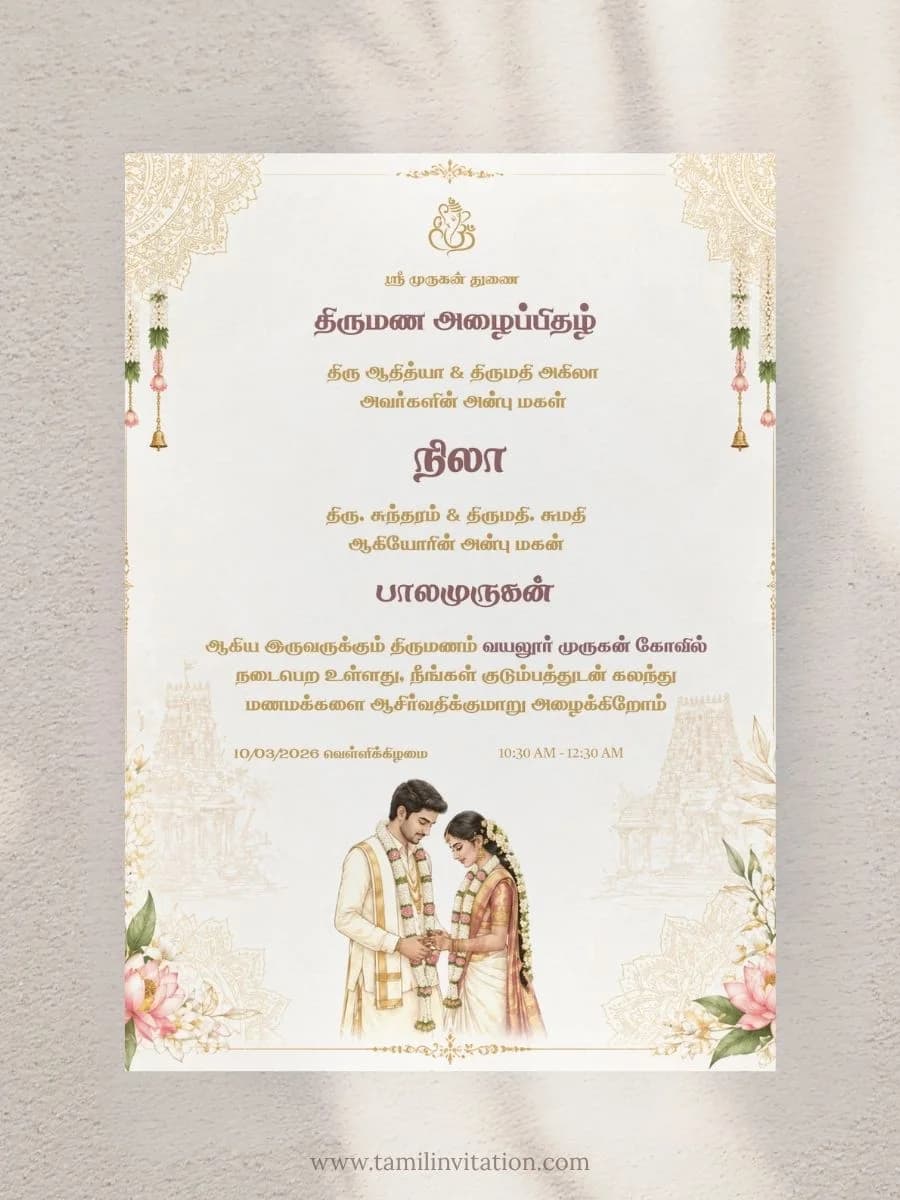
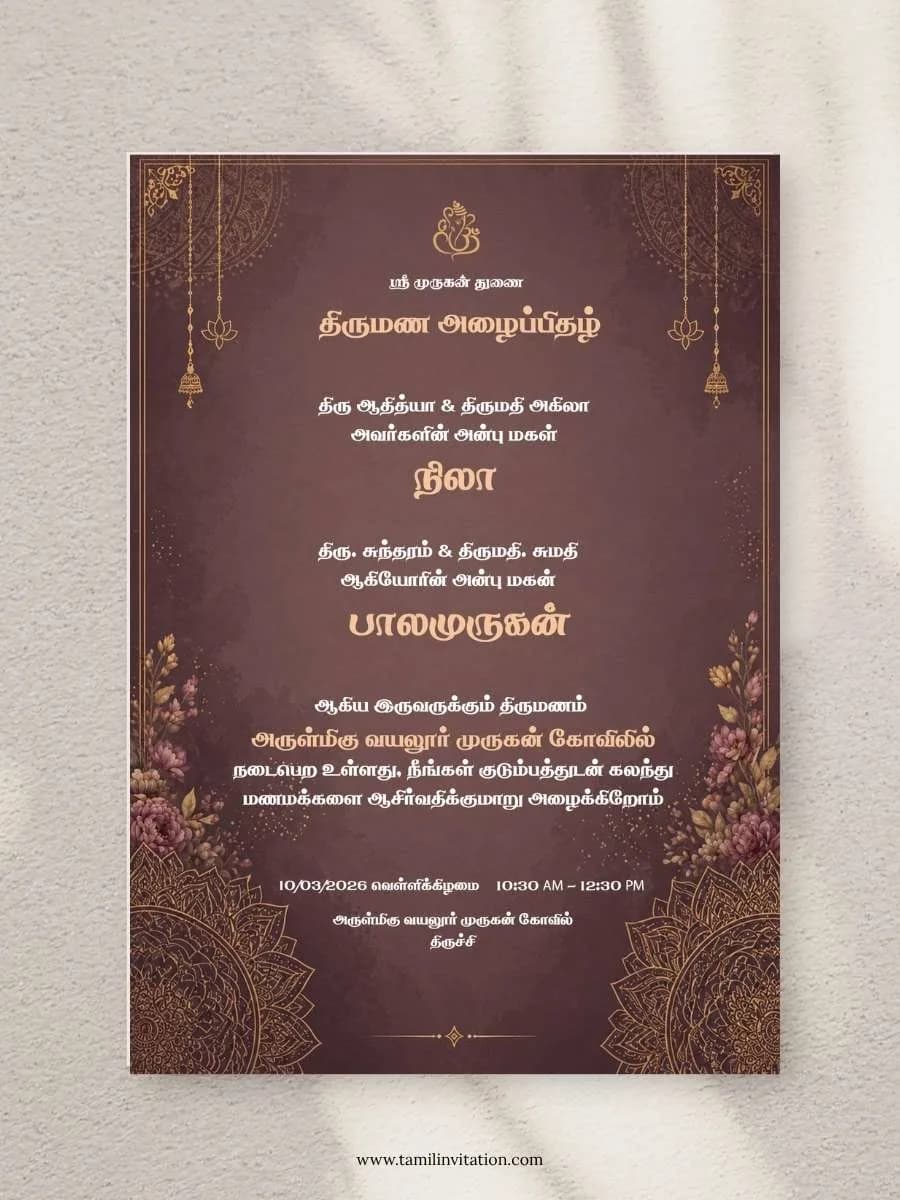
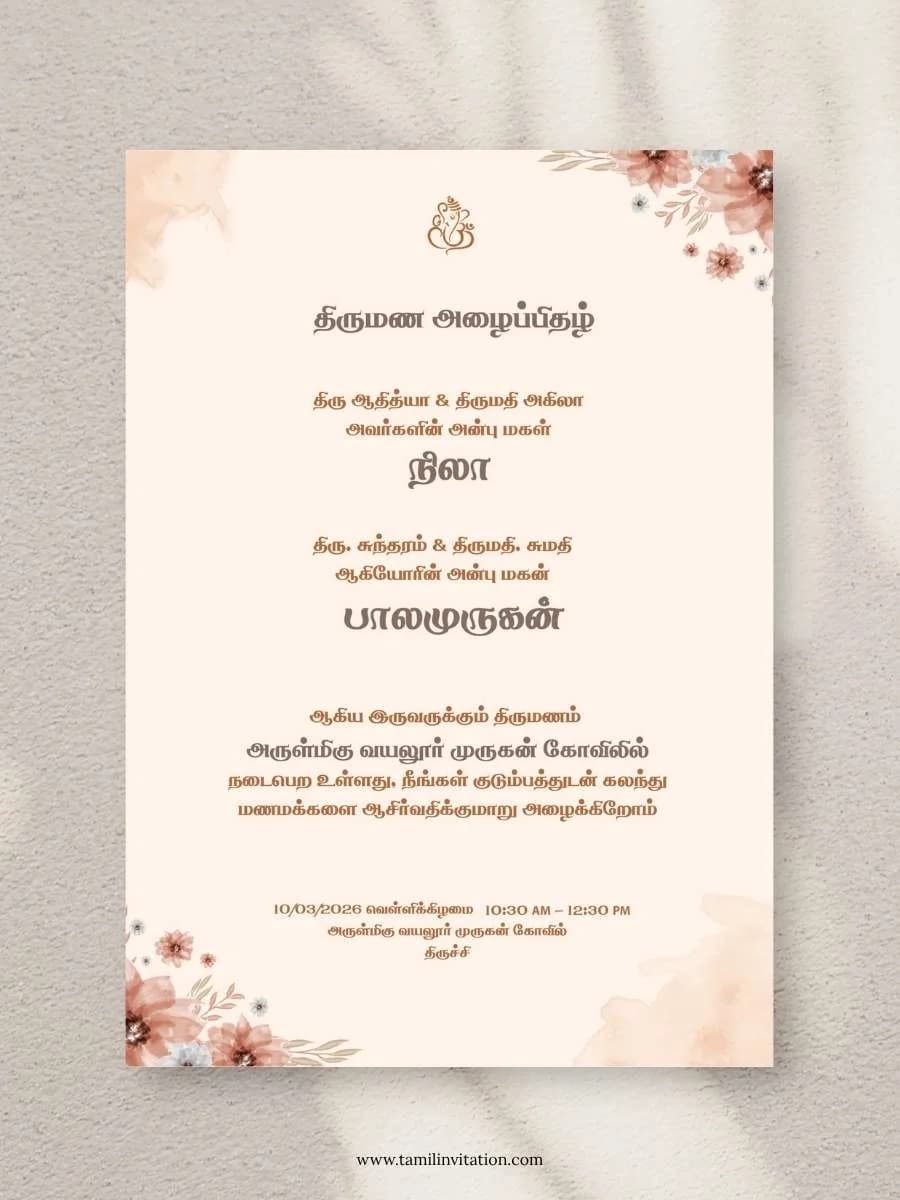
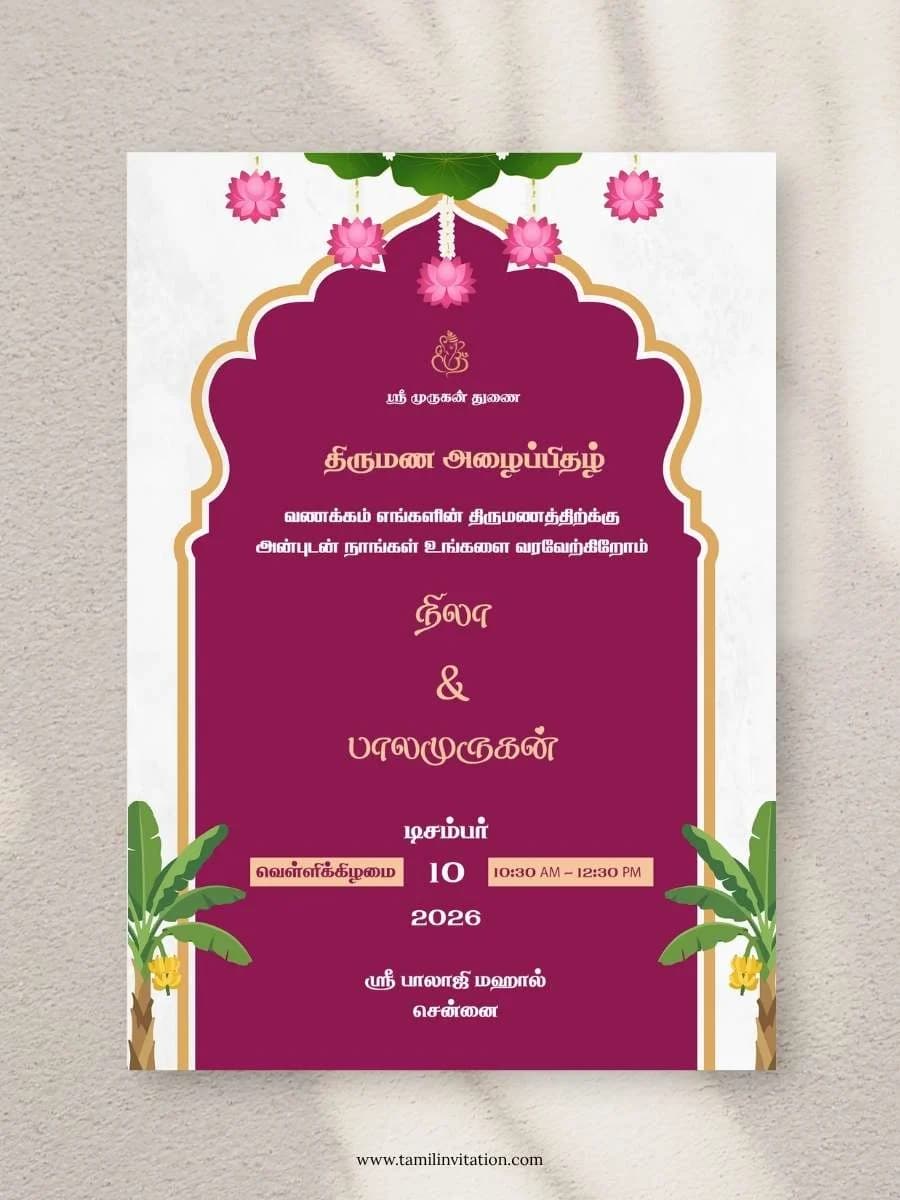
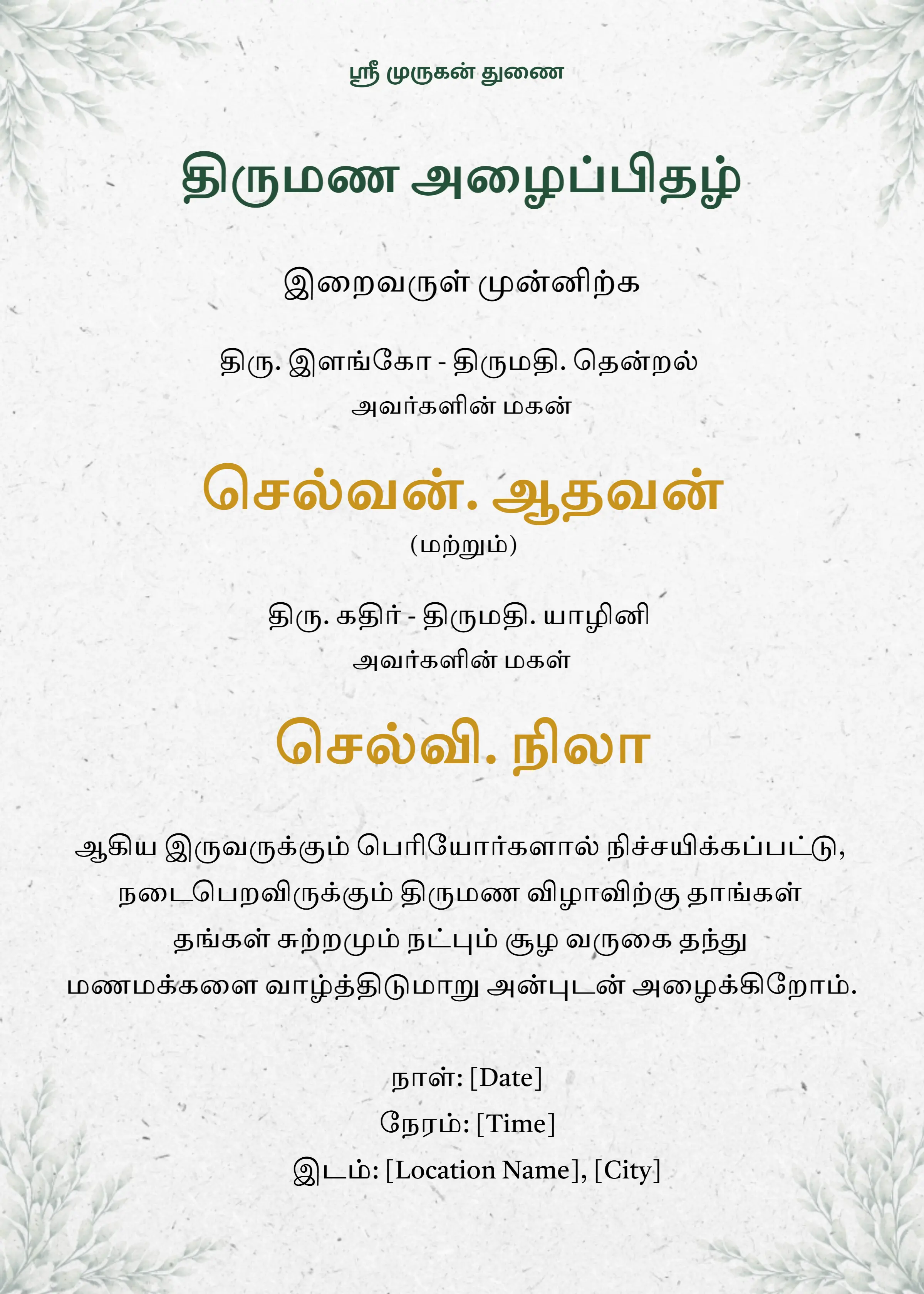
Free Tamil Marriage Invitation Templates — Download Instantly
Browse our collection of free Tamil wedding invitation templates — from classic kolam-bordered designs to modern floral themes, each crafted specifically for Tamil wedding traditions. Every Tamil marriage invitation card comes pre-filled with traditional bilingual wording, ready to personalise in seconds.
Create a beautiful Tamil marriage invitation online — completely free — in just minutes. Whether you call it a திருமண அழைப்பிதழ், a thirumana alaipithal, or a Tamil wedding e-invite, our carefully crafted templates honour every tradition that makes a Tamil wedding sacred. Enter the bride's and groom's names, parents' names, Muhurtham date and time, nakshatra, and Kalyana Mandapam address in Tamil or English. Download your finished Tamil wedding invitation card as a high-resolution image or PDF and share it on WhatsApp in seconds — no login, no design skills, no hidden charges.
How to Create a Tamil Marriage Invitation Online — எப்படி உருவாக்குவது?
Our free Tamil wedding invitation maker is designed for everyone — no design experience needed. Here's how to create your thirumana alaipithal in three easy steps:
Choose Your Tamil Wedding Invitation Design
Browse our collection of free Tamil marriage invitation templates. Select a design that fits your wedding style — traditional Brahmin kolam, elegant floral, or modern minimalist.
Fill in Your Muhurtham, Names & Venue Details
Enter the bride's and groom's names, parents' names, gothram (for Brahmin weddings), Muhurtham date and time, nakshatra, and Kalyana Mandapam address — in Tamil or English.
Preview, Download & Share on WhatsApp
Preview your Tamil wedding invitation card live, then download as a high-resolution PNG or print-ready PDF. Share instantly on WhatsApp, Facebook, or email.
Print-Ready at 300 DPI — No Extra Steps
Every Tamil marriage invitation downloads at 300 DPI — professional print quality. Take it directly to your local printing shop or order prints online without any size adjustments.
Tamil Marriage Invitation Wording — Complete Format with Sample Text
The wording of a Tamil marriage invitation is as important as its design. A proper thirumana alaipithal follows a time-honoured sequence that announces the union with cultural dignity, includes the Muhurtham details, and lists both families' lineage. Here is the complete format and wording guide — with actual sample text — that no other invitation maker provides.
What Must Every Tamil Wedding Invitation Include?
Regardless of community — Brahmin, Mudaliar, Nadar, Thevar, Gounder, Naidu, Chettiar, or Christian Tamil — every Tamil marriage invitation card must contain these essential elements:
- Divine invocation — Pillaiyar Suzhi (ஓம் / உ), Aum symbol, or community-specific deity symbol placed at the very top
- Groom's family - Father's full name, mother's full name, gothram and pravaram (for Brahmin weddings), village/town of origin
- Bride's family - Father's full name, mother's full name, gothram and pravaram (for Brahmin weddings), village/town of origin
- Couple's names - Groom's name and bride's name, prominently featured
- Muhurtham details - Auspicious date (in Tamil calendar and English date), day of week, exact Muhurtham time (e.g. 7:15 AM to 7:45 AM)
- Nakshatra and Tithi - Star (nakshatra) of the wedding day and lunar day (tithi) as per the panchangam
- Venue - Kalyana Mandapam name, complete address with landmark, city, and state
- Reception details - If applicable, separate date, time, and venue for the reception
Sample Tamil Marriage Invitation Wording — Traditional (Tamil)
ஓம் | ஸ்ரீ மகா கணபதி துணை
திருமண அழைப்பிதழ்
திரு. [மணமகன் தந்தை பெயர்] — திருமதி [தாய் பெயர்] அவர்களின்
அன்பு மகன் [மணமகன் பெயர்],
திரு. [மணமகள் தந்தை பெயர்] — திருமதி [தாய் பெயர்] அவர்களின்
அன்பு மகள் [மணமகள் பெயர்]
ஆகியோரின் திருமணம் - [நட்சத்திரம்] நட்சத்திரத்தில், [தேதி], [கிழமை] முகூர்த்தம்: காலை [நேரம்] மணி முதல் [நேரம்] மணி வரை
இடம்: [மண்டப பெயர்], [முழு முகவரி]
தாங்கள் எழுந்தருளி திருமணத்தை சிறப்பிக்க கேட்டுக்கொள்கிறோம்.
Tip: Replace all bracketed text with actual details. Our editor has dedicated fields for every line above.
Sample Tamil Marriage Invitation Wording — English
With the blessings of Lord Ganesha and our elders,
Mr. [Father's Name] and Mrs. [Mother's Name]
joyfully invite you to the wedding of their beloved son
[Groom's Name]
with [Bride's Name], beloved daughter of Mr. [Father's Name] and Mrs. [Mother's Name]
Muhurtham: [Day], [Date] at [Time] AM
Nakshatra: [Star Name] | Tithi: [Tithi Name]
Venue: [Mandapam Name], [Full Address]
Reception: [Date] at [Time] | [Venue if different]
Tamil Brahmin Wedding Invitation Wording — Iyer & Iyengar Format
Tamil Brahmin (Iyer and Iyengar) wedding invitation wording differs from other Tamil communities in several important ways. In addition to the standard details, a Tamil Brahmin marriage invitation must include:
- Groom's gothram (ancestral lineage) and pravaram (Vedic sage lineage) — e.g. "Bharadwaja Gothram, Angirasa Pravaram"
- Bride's gothram and pravaram — both families must be from different gothrams
- Sanskrit Vedic shlokas or invocations (e.g. "Mangalam Bhagavan Vishnu")
- The Panda Kaal Muhurtham details if a separate event is held the day before
- Sumangali Prarthanai event details if included in the invitation
- Both families' native village names (e.g. "Originally from Kumbakonam")
Tamil Wedding Rituals — What to Include in Your Invitation
A Tamil wedding is not a single event — it is a series of sacred rituals spanning one to three days. If your family is holding multiple functions, your Tamil marriage invitation should list each event with its date, time, and venue. Here is a complete guide to every Tamil wedding ritual and whether it belongs on your invitation:
The formal engagement ceremony where both families agree to the union and exchange gifts. Often held one to three months before the wedding. Include in invitation if held same week as wedding.
A small auspicious puja performed the evening before the wedding to consecrate the wedding pandal and seek divine blessings. Typically family-only. Include venue and time if guests attend.
A ritual where married women from both families pray for the bride's marital happiness and prosperity. Held on the morning of the wedding day. Mention date and time in the invitation.
A joyful pre-wedding celebration involving the bride and groom being playfully prepared with turmeric, music, and dance. Increasingly popular in modern Tamil weddings. Mention if guests are invited.
A charming Tamil tradition where the groom pretends to renounce worldly life and head to Kasi, only to be convinced to return and marry by the bride's father. A favourite highlight for guests.
The sacred climax of the wedding — the groom ties the thali (sacred thread) around the bride's neck with three knots as the priest chants Vedic mantras. The exact Muhurtham time is non-negotiable on the invitation.
The couple takes seven steps together around the sacred fire, each step representing a vow — health, strength, prosperity, happiness, progeny, harmony, and lifelong companionship.
The grand reception is typically held the evening of the wedding day or the following day. Always include the reception date, time, and venue separately in your Tamil marriage invitation.
The Tamil Marriage Invitation — Tradition, Symbols & Cultural Meaning
A Tamil marriage invitation is far more than a printed card or a digital image — it is the first act of the wedding itself. In Tamil tradition, the first invitation is always offered to Lord Ganesha, seeking his blessings to remove all obstacles from the couple's path. Only after this ritual act does the invitation go to elders, extended family, and friends — a sequence that reflects the deep respect for hierarchy, ritual, and community that defines Tamil culture.
Why the Tamil Wedding Invitation is Sacred
According to Tamil Agamic tradition, inviting a person to your child's wedding is itself a sacred act of grace — it is believed that the presence of elders and well-wishers brings divine blessings that strengthen the couple's union. This is why Tamil families invest time and care in the thirumana alaipithal, ensuring it correctly lists every family member and every auspicious detail.
The invitation also serves as a formal record of the two families being united — listing both families' lineage (gothram), the presiding astrologer's chosen Muhurtham, and the sacred nakshatra under which the wedding is solemnised. Many families preserve their wedding invitation as a document of genealogy for future generations.
Traditional Design Elements of a Tamil Marriage Invitation Card
Every element of the traditional Tamil wedding invitation designcarries cultural meaning. When choosing a template, look for these auspicious symbols:
The divine symbol placed at the very top of every Tamil invitation. It invokes Lord Ganesha's blessings and is considered essential — no traditional Tamil marriage invitation is complete without it.
Intricate geometric patterns drawn with rice flour at the entrance of Tamil homes to welcome guests and deities. Kolam borders on an invitation signal prosperity, purity, and auspiciousness.
The dominant colour of Tamil wedding ceremonies. Turmeric yellow on an invitation symbolises purity, health, fertility, and divine protection — the four blessings sought for every new couple.
A string of mango leaves is hung at the entrance of every Tamil wedding venue as a symbol of fertility, prosperity, and the welcoming of new life. Mango motifs on the invitation echo this sacred tradition.
The brass oil lamp is the centrepiece of every Tamil ceremony, representing the divine light of knowledge, purity, and auspiciousness. A vilakku motif on the invitation signals a ceremony conducted with full traditional respect.
The lotus flower — which rises from mud to bloom in pristine beauty — symbolises the couple's journey: rising above challenges to achieve a beautiful, pure union. A favourite motif in modern Tamil wedding invitations.
Tamil Wedding Invitation for the Diaspora — NRI Families
For Tamil families in Singapore, Malaysia, the United Kingdom, the United States, Canada, and Australia, the digital Tamil marriage invitation has become the primary mode of sharing the wedding announcement with relatives across the world. Our WhatsApp-optimised templates ensure the invitation displays perfectly on international phone screens, and the bilingual English-Tamil wording helps non-Tamil-reading relatives understand every detail of the ceremony.
Tamil Brahmin Kathani Vizha vs. General Tamil Ear Piercing Ceremony
In Tamil Brahmin families (Iyer and Iyengar communities), the Karnavedha ceremony is often combined with the Ayush Homam — a Vedic fire ritual performed on the child's first birthday or first nakshatra birthday. The invitation for Tamil Brahmin ear piercing ceremonies traditionally includes the child's gothram, the nakshatra of the ceremony, and formal Sanskrit shlokas alongside Tamil text. Our templates offer specific layouts for this style, ensuring your Kathani Vizha invitation card reflects your family's exact tradition.
Tamil Marriage Invitation — Frequently Asked Questions
Q How to create a Tamil marriage invitation online for free?
Choose a template from our free collection above, click Edit Template, and fill in the bride's and groom's names, parents' names, Muhurtham date and time, nakshatra, and venue address. Preview your திருமண அழைப்பிதழ் live, then download as a high-resolution PNG or PDF — no login, no account required. Share directly on WhatsApp in seconds.
Q What should be included in a Tamil marriage invitation?
A complete Tamil wedding invitation must include: the divine invocation (Pillaiyar Suzhi), both families' names and gothrams (for Brahmin weddings), the couple's names, Muhurtham date and exact time, nakshatra, tithi, Kalyana Mandapam name and full address, reception details (if applicable), and RSVP contact number. Our templates have dedicated fields for every one of these elements.
Q How to write a Tamil wedding invitation wording?
Tamil wedding invitation wording follows a set cultural sequence: begin with the divine invocation, then list the groom's parents with their gothram, followed by the bride's parents with their gothram, then the couple's names, then the Muhurtham date, time, and nakshatra, followed by the venue address. The wording section above this FAQ has complete sample text in both Tamil and English — copy and customise freely.
Q What is Muhurtham and why is it the most important detail on a Tamil marriage invitation?
Muhurtham is the auspicious time fixed by the family priest (vadhyar) using the Tamil panchangam (almanac) — typically a window of 30 to 45 minutes during which the thali-tying ritual (Mangalya Dharanam) must be completed. It is determined based on the nakshatra, tithi, and rasi of the couple. The Muhurtham time is non-negotiable — guests are expected to arrive before it begins, making it the single most critical piece of information on any Tamil marriage invitation card.
Q What is the difference between a Tamil Brahmin wedding invitation and other Tamil invitations?
Tamil Brahmin (Iyer and Iyengar) wedding invitations include the gothram and pravaram (Vedic sage lineage) of both families, Sanskrit shlokas, and sometimes details of the Panda Kaal Muhurtham and Sumangali Prarthanai. Other Tamil community invitations focus on the Muhurtham time, nakshatra, family names, temple affiliation, and kula deivam (family deity). Our templates offer separate wording formats for both styles.
Q Can I download a Tamil marriage invitation without watermark for free?
Free templates can be downloaded with a small watermark to preview quality. Our premium Tamil wedding invitation templates are available as watermark-free, full-resolution downloads (PNG at 300 DPI and PDF) at a nominal cost — no subscription or account needed. You pay once per invitation, not per use
Q Can I create a Tamil marriage invitation on my mobile phone?
Yes. Our Tamil marriage invitation maker is fully mobile-optimised and works on all Android and iOS browsers without any app download. Design, customise, preview, and download your திருமண அழைப்பிதழ் directly from your smartphone and share it on WhatsApp within minutes.
Q Can I print the Tamil marriage invitation card downloaded from this site?
Yes. Premium templates download at 300 DPI — professional print quality suitable for A5 or A6 printed cards. Take the PDF file directly to your local printing shop (e.g. any print shop in Chennai, Coimbatore, Madurai, or online print services) and they can print it without any size adjustments.
Q How to invite friends for marriage in Tamil?
For friends, choose one of our modern or floral Tamil wedding invitation designs and add a personal message in Tamil or English using the text editor. Download the finished card as a WhatsApp-ready image and send it in your wedding WhatsApp group. For a more personal touch, add the couple's photo using our image upload feature and write a short message in Tamil below the invitation details.
Q What Tamil wedding rituals should I mention in the invitation?
If you are holding multiple functions, list each with its date, time, and venue. Commonly mentioned Tamil wedding events include: Nichayathartham (engagement), Pandakal Muhurtham (eve puja), Sumangali Prarthanai, Nalangu (pre-wedding), the main Muhurtham (thali tying), and the Reception (Valaipaadu). The Tamil Wedding Rituals section above explains each event in detail so you know what to include and what to leave out.
More Free Tamil Invitation Makers
Planning other Tamil ceremonies alongside your wedding? Explore our complete range of free Tamil invitation makers — all with traditional designs, bilingual editors, and instant WhatsApp-ready downloads: